The Hidden SEO Challenge in Custom Websites: SEO and Developer Misalignment
Explore why custom website SEO fails when developers and SEO specialists misalign. Real solutions for effective technical SEO implementation.

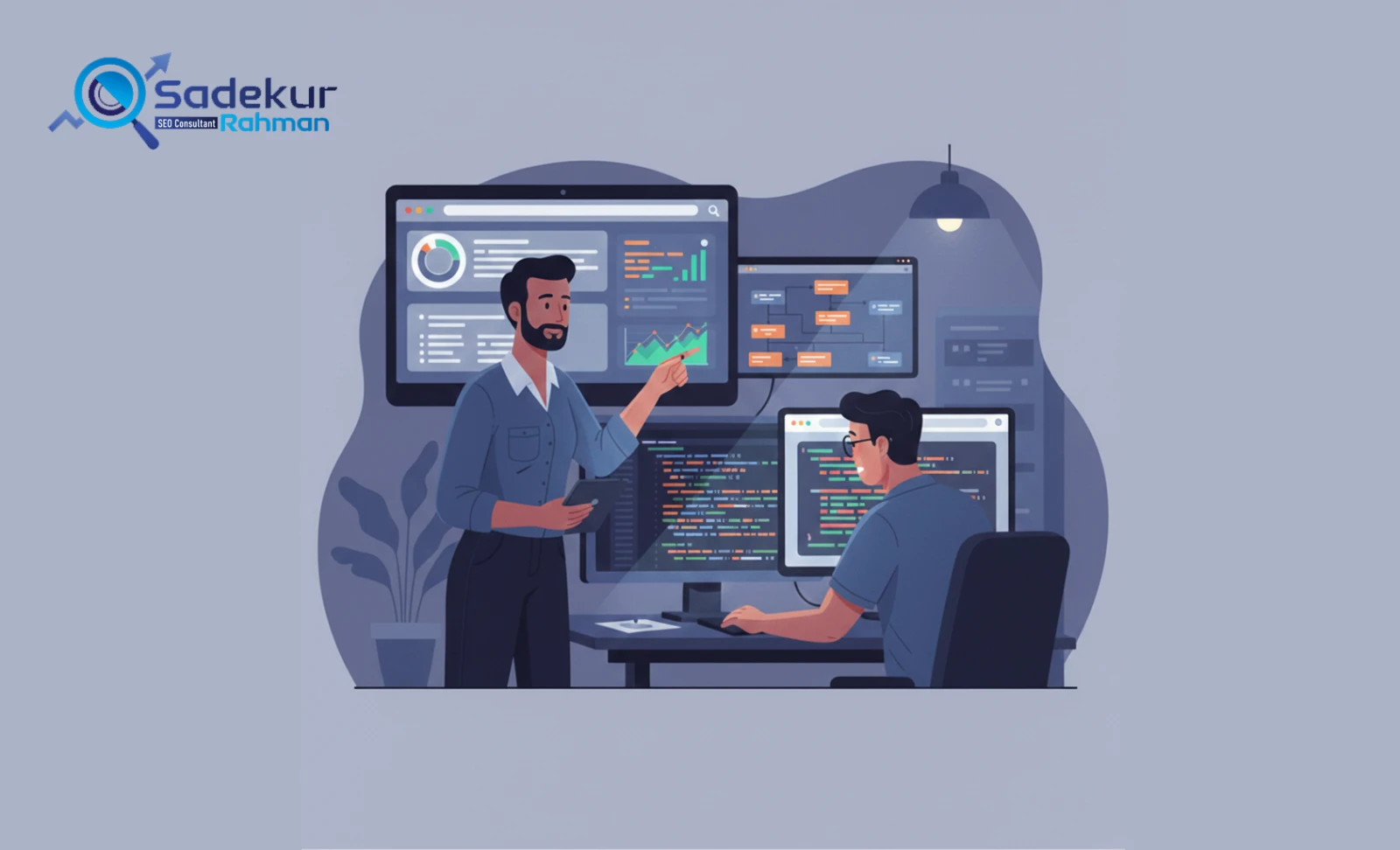
Custom website development presents unique technical SEO challenges that rarely exist in managed platforms like WordPress or Shopify. When development teams control entire codebases and architectural decisions, every SEO improvement—from canonical tags to sitemap logic—depends on developer understanding, prioritization, and correct implementation.
According to the 2026 State of SEO report, cross-department collaboration currently shows the lowest impact at 9 percent, though 37 percent expect to increase it in 2026. This gap represents a critical challenge facing SEO specialists working on custom-built websites where technical implementation barriers directly impact search visibility.
This article examines the hidden but widespread problem of developer misalignment in custom website environments, exploring why it occurs, how it manifests, and proven strategies for effective collaboration based on real-world experience.
What is Developer Misalignment in SEO?
Developer misalignment in SEO refers to the disconnect between SEO requirements and development priorities, understanding, or execution in custom website projects. This misalignment occurs when development teams prioritize functionality, performance, or delivery timelines while underestimating or misunderstanding the search engine optimization implications of architectural and technical decisions.
The Custom Website Challenge
Unlike content management systems with built-in SEO capabilities, custom websites require manual implementation of every SEO feature. Developers must understand not just what to implement, but why it matters for search engines and how incorrect implementation affects visibility.
Common custom website scenarios:
- Bespoke frameworks: Proprietary code without SEO plugins or modules
- Headless architectures: Decoupled front-end and back-end systems requiring careful JavaScript rendering
- Custom CMSs: Internal content management systems lacking SEO functionality
- Microservices: Distributed architectures where SEO logic must span multiple services
Each scenario demands developer expertise in SEO principles, creating dependency relationships where technical SEO success hinges on development execution quality.
Why Developer Misalignment Occurs
Several systemic factors contribute to SEO-developer disconnection:
Different educational backgrounds:
Developers learn programming languages, software architecture, and performance optimization. SEO rarely appears in computer science curricula. Understanding how search engines work, why canonical tags matter, or how crawl budget optimization affects large sites requires specialized knowledge developers typically don't acquire through formal education.
Priority misalignment:
Developers focus on functionality ("does it work?"), performance ("is it fast?"), and code quality ("is it maintainable?"). SEO concerns like proper heading hierarchy, semantic HTML structure, or URL architecture often seem secondary to these core engineering priorities.
According to 2026 industry research, SEO teams lack authority to influence upstream decisions, meaning architectural choices affecting SEO often occur before SEO specialists even review requirements.
Language barriers:
SEO specialists describe requirements using search marketing terminology—"implement hreflang tags," "fix canonical chains," "optimize crawl efficiency." Developers think in implementation terms—"add attribute to link element," "prevent redirect loops," "cache static resources." This linguistic gap creates communication friction and misunderstanding.
For comprehensive understanding of SEO-development collaboration challenges, review our guide on diagnosing complex SEO problems.
Common Manifestations of Developer Misalignment
Developer misalignment creates predictable, recurring problems in custom website projects.
Problem 1: SEO Recommendations Dismissed as "Not Required"
When SEO specialists request implementation of canonical tags, structured data, or proper redirect handling, developers sometimes categorize these as optional enhancements rather than critical requirements.
Example scenario:
SEO: "We need to implement canonical tags on all pages to consolidate duplicate URL variations."
Developer: "The site works fine without them. This isn't required for core functionality."
Result: Duplicate content issues, URL parameter problems, crawl budget waste.
This dismissal stems from developers not understanding the revenue impact of technical SEO problems. Without seeing direct cause-effect relationships between missing canonicals and reduced organic traffic, developers naturally prioritize visible functionality over invisible SEO infrastructure.
Problem 2: Misunderstood Requirements Leading to Incorrect Implementation
Even when developers accept SEO requirements, technical language gaps create implementation errors.
Real-world example: Pagination handling
SEO Request: "Implement rel=next and rel=prev for paginated category pages."
Developer Implementation:
<link rel="next" href="/category?page=2">
<link rel="prev" href="/category?page=1">
Problem: Missing canonical tags, incorrect relative URLs, broken pagination series.
The developer technically implemented what was requested but missed critical context about how pagination SEO actually works, resulting in implementation that satisfies the literal requirement while failing to solve the underlying problem.
Problem 3: Delayed Implementation Due to Perceived Low Business Impact
Sprint planning and task prioritization often deprioritize SEO work in favor of features perceived as directly revenue-driving.
Typical priority hierarchy:
| Task Type | Developer Priority | SEO Impact | Actual Business Value |
|---|---|---|---|
| New feature launch | Critical | Low | Medium (new functionality) |
| Bug fix affecting UI | High | None | Medium (user experience) |
| Performance optimization | High | None | High (speed affects SEO too) |
| Schema markup implementation | Low | High | High (rich results, CTR) |
| Canonical tag fixes | Low | Critical | Critical (indexation, rankings) |
| Sitemap automation | Low | High | High (discovery, crawl efficiency) |
This misalignment means crawl errors, indexation problems, and duplicate content issues persist for weeks or months while new features ship continuously.
Problem 4: Lack of SEO Consideration in Architectural Decisions
Major architectural choices affecting SEO happen during initial planning phases when SEO specialists often aren't consulted.
Common problematic decisions:
Client-side routing in JavaScript frameworks:
- Developers choose React/Vue for development experience
- Single-page application architecture creates crawling challenges
- JavaScript rendering problems discovered months later
Dynamic URL parameter handling:
- Filter systems generate thousands of crawlable parameter combinations
- No robots.txt or canonical strategy considered during design
- Results in crawl budget waste affecting entire site
Subdomain proliferation:
- Marketing launches microsites on different subdomains
- No domain strategy considering link equity and authority distribution
- Creates fragmented SEO presence requiring complex fixes
According to enterprise SEO research, large organizations face challenges like multiple teams, approval processes, and complex workflows that exacerbate these architectural blind spots.
Problem 5: No Ownership of SEO Implementation
When SEO requirements exist but no clear owner ensures correct implementation, tasks fall into gaps between teams.
Responsibility confusion:
- Front-end developers: "I just implement what's in the design. SEO should be specified."
- Back-end developers: "SEO is front-end—meta tags, headers, HTML structure."
- DevOps: "We handle infrastructure. Application logic is development's domain."
- SEO specialists: "We provide requirements. Implementation is development's job."
This ownership vacuum means critical SEO elements like schema markup, proper heading structure, and internal linking architecture often lack champions ensuring correct execution.
Critical SEO Areas Most Affected by Developer Misalignment
Certain technical SEO elements consistently fail due to developer misunderstanding or misimplementation.
Canonical Tag Implementation
Canonical tags consolidate duplicate content but require nuanced understanding of when and how to implement them.
Common implementation errors:
<!-- ERROR: Canonical pointing to non-existent page -->
<link rel="canonical" href="https://example.com/deleted-page" />
<!-- ERROR: Relative URL instead of absolute -->
<link rel="canonical" href="/product-page" />
<!-- ERROR: Canonical to different content -->
<link rel="canonical" href="https://example.com/category/" />
<!-- On product page -->
<!-- ERROR: Canonical chain (A→B→C) -->
<!-- Page A canonicals to B, which canonicals to C -->
<!-- CORRECT: Self-referencing on canonical page -->
<link rel="canonical" href="https://example.com/product-page/" />
<!-- CORRECT: Non-canonical variations point to canonical -->
<link rel="canonical" href="https://example.com/product-page/" />
<!-- On /product-page?ref=newsletter -->
When developers implement canonicals without understanding their purpose—consolidating duplicate signals while allowing multiple access paths—they create canonical chains, loops, or incorrect targeting that Google may ignore entirely.
Sitemap Generation and Logic
Sitemaps require strategic logic about what to include, exclude, and how to organize URLs.
Developer vs. SEO understanding:
Developer thinking: "Sitemap = list of all URLs on the site. Generate programmatically from database."
SEO requirement:
- Include only indexable, canonical URLs
- Exclude noindex pages
- Exclude parameter variations
- Organize by content type
- Include proper
<lastmod>timestamps - Split large sitemaps by date or type
- Exclude low-quality pages wasting crawl budget
Without SEO context, developers create monolithic sitemaps listing every URL including duplicates, test pages, and filtered variations, undermining the sitemap's purpose.
For comprehensive sitemap strategy, review our guide on creating scalable sitemaps for enterprise websites.
URL Structure and Redirect Handling
URL architecture decisions made early persist throughout a site's lifetime, affecting SEO fundamentally.
Problematic URL patterns developers create:
/product.php?id=12345 (database-driven, not semantic)
/en/us/products/category/subcategory/sub-subcategory/product-name (too deep)
/products/mens-shoes?color=black&size=10&sort=price&filter=sale (parameter soup)
When developers prioritize technical convenience over SEO best practices, URLs become:
- Non-descriptive and unfriendly to users and engines
- Excessively deep, pushing content many clicks from homepage
- Parameter-heavy, creating millions of duplicate variations
Redirect implementation problems:
Redirect chains occur when developers layer redirects without considering cumulative impact:
Original URL → Redirect 1 → Redirect 2 → Redirect 3 → Final URL
Each hop:
- Increases page load time
- Loses approximately 15% link equity
- May cause Google to abandon following the chain
Developers often add redirects reactively rather than planning comprehensive redirect strategies during site migrations.
Pagination and Infinite Scroll
Pagination and infinite scroll require careful implementation to avoid duplicate content and indexation problems.
Pagination implementation errors:
<!-- Page 2 of category -->
<!-- ERROR: Missing canonical to view-all or self-referencing -->
<!-- ERROR: No rel=prev pointing to page 1 -->
<!-- ERROR: No rel=next pointing to page 3 -->
<!-- CORRECT Implementation -->
<link rel="canonical" href="https://example.com/category?page=2" />
<link rel="prev" href="https://example.com/category" />
<link rel="next" href="https://example.com/category?page=3" />
Infinite scroll creates worse problems when developers don't provide fallback pagination or implement history states allowing direct URL access to scrolled content.
Schema Markup and Structured Data
Schema markup requires understanding both JSON-LD syntax and semantic web concepts.
Common developer mistakes:
{
  "@context": "https://schema.org",
  "@type": "Product",
  "name": "Example Product",
  "image": "relative-path/image.jpg",
  "offers": {
    "@type": "Offer",
    "price": "19.99"
  }
}
// PROBLEMS:
// - Missing required properties (description, brand)
// - Relative image URL instead of absolute
// - Missing priceCurrency
// - No availability information
// - Should include aggregateRating if reviews exist
Developers often implement minimal schema satisfying syntax validators while missing semantic requirements that actually drive rich results and enhanced SERP features.
Fix schema errors using our comprehensive guide on fixing schema markup errors.
Indexation Controls and Meta Robots
Controlling what search engines index requires correct meta robots implementation across templates.
Critical errors:
<!-- ERROR: Noindex on important pages -->
<meta name="robots" content="noindex, follow" />
<!-- On category pages that should rank -->
<!-- ERROR: Nofollow blocking link equity flow -->
<meta name="="robots" content="index, nofollow" />
<!-- Preventing internal linking value -->
<!-- ERROR: Conflicting signals -->
<!-- Meta tag says noindex, robots.txt blocks, canonical points elsewhere -->
When developers don't understand the relationship between robots.txt, meta robots tags, and X-Robots-Tag headers, they create conflicting directives confusing search engines about indexation intent.
Best Practices for Effective SEO-Developer Collaboration
Bridging the SEO-developer gap requires systematic approaches addressing communication, prioritization, and shared understanding.
Strategy 1: Translate SEO Requirements into Developer-Friendly Specifications
Industry research shows that the ability to communicate technical insights in plain business language is critical for 2026 SEO success.
Before (SEO-speak): "Implement canonical tags to consolidate parameter variations and prevent duplicate content issues affecting crawl efficiency."
After (developer-friendly):
Technical Requirement: Add canonical link element
Implementation: <link rel="canonical" href="[PRIMARY_URL]" />
Placement: HTML <head> section
Logic:
  - If URL contains parameters (?ref=, ?utm_, ?sort=): canonical = base URL without parameters
  - If URL is base URL: canonical = self-referencing (same URL)
Test Cases:
  - /product → canonical: /product
  - /product?ref=email → canonical: /product
  - /product?utm_source=google → canonical: /product
Validation: Check HTML source, verify absolute URLs, confirm no redirect chains
This specification provides:
- What to implement (technical requirement)
- Where to place it (implementation location)
- When to use different values (conditional logic)
- How to verify correctness (test cases)
Strategy 2: Use Data from Crawl Reports and Search Console
Technical data speaks louder than abstract SEO theory to developers.
Effective data presentation:
Issue: Canonical tag errors
Scale: 15,742 pages affected (42% of site)
Impact: Google Search Console shows "Duplicate, submitted URL not selected as canonical"
Business Cost: Estimated $18,000 monthly revenue loss from reduced indexation
Evidence:
- Screaming Frog crawl: 15,742 pages with canonical pointing to 404
- Search Console: 12,458 "excluded" pages due to canonical errors
- Analytics: 28% traffic drop on affected product categories
Fix Priority: Critical (P0)
Developer Effort: Medium (4-6 hours)
Expected Recovery: 25-35% traffic increase within 30 days
Developers respond to quantified problems with clear business impact rather than theoretical SEO best practices.
Strategy 3: Prioritize Fixes Based on Business Impact
Not all SEO issues deserve equal priority. Commercial impact understanding helps developers see SEO as revenue-driving rather than optional optimization.
Priority matrix:
| Issue Type | Business Impact | Implementation Effort | Priority |
|---|---|---|---|
| Canonical errors on product pages | High (direct revenue) | Low | P0 - Critical |
| Missing schema on articles | Medium (CTR improvement) | Medium | P1 - High |
| Sitemap organization | High (crawl efficiency) | High | P1 - High |
| Pagination on blog archives | Low (low-traffic pages) | High | P3 - Low |
| Alt text on decorative images | Low (minimal SEO value) | Low | P4 - Optional |
This framework helps development teams understand why some SEO tasks deserve immediate attention while others can wait for future sprints.
Strategy 4: Create Shared SEO Documentation
Documentation reduces recurring questions and provides developers with self-service references.
Essential documentation:
SEO implementation checklist:
- Required meta tags for all page types
- Canonical tag logic and examples
- Schema markup templates
- URL structure standards
- Redirect implementation rules
- Sitemap inclusion/exclusion criteria
Testing procedures:
- Pre-launch SEO validation
- Tools to use (Screaming Frog, Search Console URL Inspection)
- What to check before deployment
- Who approves SEO implementation
Common mistake catalog:
- Real examples of past implementation errors
- Why each was problematic
- How to avoid repeating them
Industry insights reveal that SEO documentation and clear ownership significantly improve cross-team effectiveness.
Strategy 5: Establish SEO Review Gates in Development Workflow
Integrating SEO checkpoints into existing development processes ensures nothing ships without validation.
Development workflow integration:
Requirements Phase:
- SEO reviews architectural decisions
- SEO provides technical specifications
- SEO included in sprint planning
Development Phase:
- SEO reviews pull requests touching SEO-critical code
- Automated tests check technical SEO requirements
- SEO validates on staging environment
Pre-Launch Phase:
- Comprehensive SEO audit of staging site
- Resolution of critical and high-priority issues
- SEO sign-off required before production deployment
Post-Launch Phase:
- Search Console monitoring for crawl/index errors
- Analytics tracking for traffic impact
- Regular SEO-development retrospectives
This systematic integration prevents SEO from being an afterthought discovered during launch week.
Strategy 6: Provide SEO Training for Development Teams
Education reduces future misalignment by building shared knowledge.
Developer SEO training curriculum:
Module 1: How Search Engines Work (2 hours)
- Crawling, rendering, indexing basics
- How Google processes JavaScript
- Why page speed affects rankings
Module 2: Technical SEO Fundamentals (3 hours)
- URL structure and architecture
- Canonical tags and duplicate content
- Redirects and status codes
- Meta robots and indexation control
- Site architecture principles
Module 3: Implementation Best Practices (2 hours)
- Schema markup implementation
- Sitemap generation
- Pagination handling
- Hreflang for international sites
Module 4: Testing and Validation (1 hour)
- Tools for SEO testing
- Pre-launch validation procedures
- Search Console fundamentals
Investment in developer SEO education pays compound dividends through reduced implementation errors and proactive SEO consideration.
Strategy 7: Use Automated Testing for Technical SEO Requirements
Automated tests catch SEO problems before they reach production.
Testable SEO requirements:
// Example: Automated test for canonical tags
describe('Canonical Tag Implementation', () => {
  test('All pages include canonical tag', () => {
    const pages = getAllPages();
    pages.forEach(page => {
      const canonical = page.querySelector('link[rel="canonical"]');
      expect(canonical).toBeTruthy();
    });
  });

  test('Canonical URLs are absolute, not relative', () => {
    const canonical = getCanonicalTag();
    expect(canonical.href).toMatch(/^https?:\/\//);
  });

  test('Canonical does not point to 404 page', () => {
    const canonicalUrl = getCanonicalUrl();
    const response = fetch(canonicalUrl);
    expect(response.status).toBe(200);
  });
});
Automated testing shifts SEO validation left in the development cycle, catching problems during coding rather than after deployment.
Real-World Case Study: News Website Custom CMS
Based on direct experience working with a development team on a custom news website content management system:
Project context:
- Custom-built CMS controlling 50,000+ articles
- Development team: 6 developers, no prior SEO experience
- Publishing frequency: 50-100 articles daily
- SEO specialist: External consultant (limited access to codebase)
Initial problems discovered:
- Sitemap issues:
- Single monolithic sitemap with 87,000 URLs
- Included noindex pages, parameter variations, test articles
- No date-based organization
- Caused "Sitemap too large" Search Console errors
- Canonical problems:
- Articles accessible via 3-4 category URLs
- No canonical tags implemented
- Created massive duplicate content issues
- Schema markup:
- NewsArticle schema missing entirely
- Developers unaware of Google News requirements
Collaboration challenges encountered:
Week 1-2: SEO recommendations submitted via email documentation
- Developer response: "Not priority, feature development takes precedence"
- No implementation progress
Week 3-4: Created visual diagram showing revenue impact
- Search Console screenshot showing 53,000 "Discovered - not indexed" URLs
- Analytics data showing 40% traffic decline over 6 months
- Estimated monthly revenue loss: $22,000
- Developer response shifted to "We'll schedule this"
Week 5-8: Provided exact code specifications
- Detailed sitemap structure with implementation examples
- Canonical tag logic with PHP code samples
- Schema markup templates for NewsArticle
- Weekly calls reviewing implementation progress
Results after 12 weeks:
- Sitemaps reorganized: news-sitemap.xml (48-hour articles), article-sitemap-YYYY-MM.xml (archived)
- Canonical tags implemented site-wide
- NewsArticle schema on all articles
- Indexed pages: 87,000 → 48,000 (removing duplicates)
- New article indexation: 24-48 hours → 2-4 hours
- Organic traffic: +42% recovery within 90 days
Key lessons:
- Data persuades: Traffic graphs and revenue estimates motivated action more than SEO theory
- Specificity matters: Code examples eliminated implementation ambiguity
- Regular communication: Weekly sync calls maintained momentum and addressed questions immediately
- Quick wins build trust: Sitemap fixes showed fast results, justifying further SEO investment
This experience demonstrates that developer misalignment is solvable through strategic communication, clear specifications, and persistent collaboration.
Professional SEO Implementation Support
Complex custom websites often require expert guidance bridging SEO strategy and technical implementation, particularly when development teams lack SEO expertise or bandwidth.
If your custom website experiences:
- Declining organic traffic despite content efforts
- Indexation problems affecting visibility
- Technical SEO errors persistent despite attempted fixes
- Developer resistance to SEO requirements
- Lack of SEO ownership in development workflow
Professional SEO services can provide:
- Technical SEO audits identifying implementation gaps
- Developer-friendly specification documentation
- Code review and validation
- Training for development teams
- Ongoing monitoring and optimization
As an SEO specialist, I help organizations bridge the gap between SEO requirements and development execution through:
- Technical SEO audits diagnosing implementation problems
- Detailed specification creation developers can directly implement
- Training sessions building shared SEO-development understanding
- Collaborative workflow establishment
- Post-implementation validation and monitoring
Book a meeting to discuss your specific developer collaboration challenges, or contact me for preliminary assessment of your custom website's technical SEO implementation quality.
You can also explore my plans and pricing or review case studies showing real results from improved SEO-developer collaboration on custom websites.
Frequently Asked Questions
Why is SEO-developer collaboration particularly challenging on custom websites?
Custom websites lack the built-in SEO functionality of platforms like WordPress, Shopify, or managed solutions. Every SEO feature—from canonical tags to sitemaps to schema markup—requires manual development implementation. Unlike plugin-based platforms where SEO specialists can directly configure settings, custom sites create dependencies where SEO success requires developer understanding and correct execution. This dependency, combined with developers' typical lack of SEO training, creates implementation gaps where requirements are misunderstood, deprioritized, or incorrectly executed.
How can I convince developers that SEO requirements are business-critical?
Translate SEO issues into quantified business impact using data from Google Search Console, analytics, and crawl tools. Show specific numbers: "15,742 pages have canonical errors causing Google to exclude them from indexing. Analytics shows a 28% traffic drop on these pages over 90 days, representing estimated $18,000 monthly revenue loss." Developers respond to concrete evidence of problems affecting revenue more than abstract SEO theory. Supplement data with competitive analysis showing how competitors ranking above you have correctly implemented the features you're requesting.
What's the most common canonical tag mistake developers make?
The most frequent error is implementing canonical tags that point to non-existent, redirected, or incorrect URLs. Developers often hard-code canonical values during initial development, then fail to update them when URL structures change, pages are deleted, or content moves. Another common mistake is using relative URLs (/product-page) instead of absolute URLs (https://example.com/product-page), which can break when pages are accessed via different protocols or domains. These errors cause Google to ignore canonical suggestions entirely, defeating their purpose of consolidating duplicate content signals.
Should SEO specialists learn to code to work more effectively with developers?
Basic understanding of HTML, CSS, and how web pages render helps SEO specialists communicate more precisely and identify implementation problems, but deep programming expertise usually isn't necessary. More valuable skills include: reading and understanding HTML source code, using browser developer tools to inspect pages, understanding HTTP status codes and redirects, basic JavaScript comprehension (especially for modern frameworks), and ability to write clear technical specifications. Focus on bridging language rather than becoming a developer yourself—your expertise in search engine behavior and optimization strategy provides more value than redundant coding ability.
How do I prioritize SEO fixes when developers say everything is low priority?
Use impact-effort matrices quantifying business value and implementation cost. Create a priority framework with clear criteria: P0 (Critical) for issues directly preventing indexation or causing de-indexation, revenue loss >$5K monthly, or security/compliance problems; P1 (High) for issues affecting >10% of pages, traffic loss >1K monthly visitors, or preventing feature launches; P2 (Medium) for optimization improvements with measurable but non-critical impact; P3 (Low) for minor enhancements with uncertain ROI. Present this framework to development leadership, get agreement on priority definitions, then classify all SEO tasks within this shared system.
What should be included in SEO technical specifications for developers?
Effective specifications include: what to implement (technical requirement name), where to place it (HTML location, code file, or system component), when to apply it (page types, conditions, URL patterns), how to implement it (code examples in relevant languages), validation criteria (how to verify correct implementation), test cases (specific examples with expected outputs), and common mistakes to avoid (real errors from similar projects). Include visual examples like screenshots or diagrams. Avoid SEO jargon; use technical terminology developers understand. Provide working code samples they can adapt rather than descriptions requiring interpretation.
How can automated testing help ensure SEO implementation quality?
Automated tests validate technical SEO requirements during development before changes reach production. Tests can verify: canonical tags exist and use absolute URLs, schema markup is present and valid, meta robots tags don't accidentally noindex important pages, redirects don't create chains or loops, sitemaps include correct URLs and proper formatting, heading hierarchies follow proper structure, and URLs match approved patterns. Integrate these tests into continuous integration pipelines so pull requests failing SEO tests can't merge until fixed. This "shift-left" approach catches problems during coding rather than after deployment, reducing emergency fixes and launch delays.
What metrics should I track to demonstrate SEO improvement after developer collaboration?
Monitor these key metrics showing technical SEO health: indexed pages (Search Console Coverage report—should increase toward total submitted in sitemaps), crawl errors (should decrease toward zero), average indexation speed (time from publication to indexation—should decrease), "Discovered - currently not indexed" pages (should decrease significantly), duplicate content warnings (should approach zero), schema markup valid implementations (should increase toward 100% of relevant pages), and ultimately, organic traffic and conversions from SEO-targeted landing pages. Create dashboards showing these metrics before and after technical implementations, demonstrating clear improvements from correct developer execution of SEO requirements.
How do I handle situations where developers claim SEO requirements will break the site?
Request specific technical explanation of how the SEO implementation would cause problems. Often "will break the site" means "will require refactoring existing code" or "conflicts with how we currently do things." Work collaboratively to find implementation approaches satisfying both SEO requirements and technical constraints. For example, if implementing proper canonical tags requires database schema changes, explore alternative solutions like middleware intercepting responses to add canonical headers. Sometimes "breaking" concerns reveal legitimate technical debt requiring resolution anyway—SEO requirements can be catalysts for overdue architectural improvements benefiting the entire application beyond just search optimization.
For more technical SEO insights, explore our related content on technical SEO tips, website development, and SEO services.

Written by Sadekur Rahman
SEO & Website Strategy Specialist at Pixelvega and SEO Executive at Daily Amar Desh. 6+ years helping brands grow with data-driven SEO.